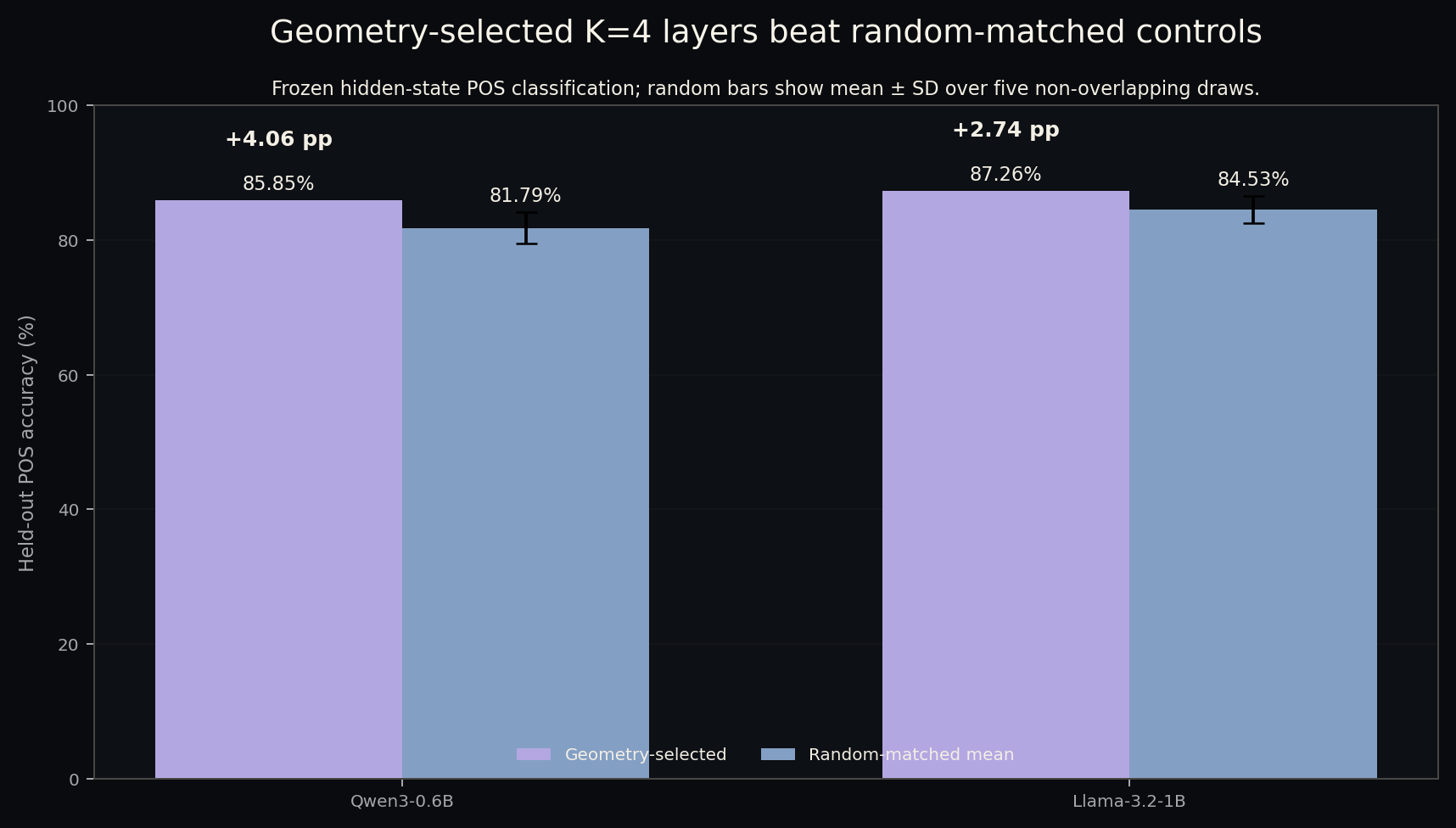
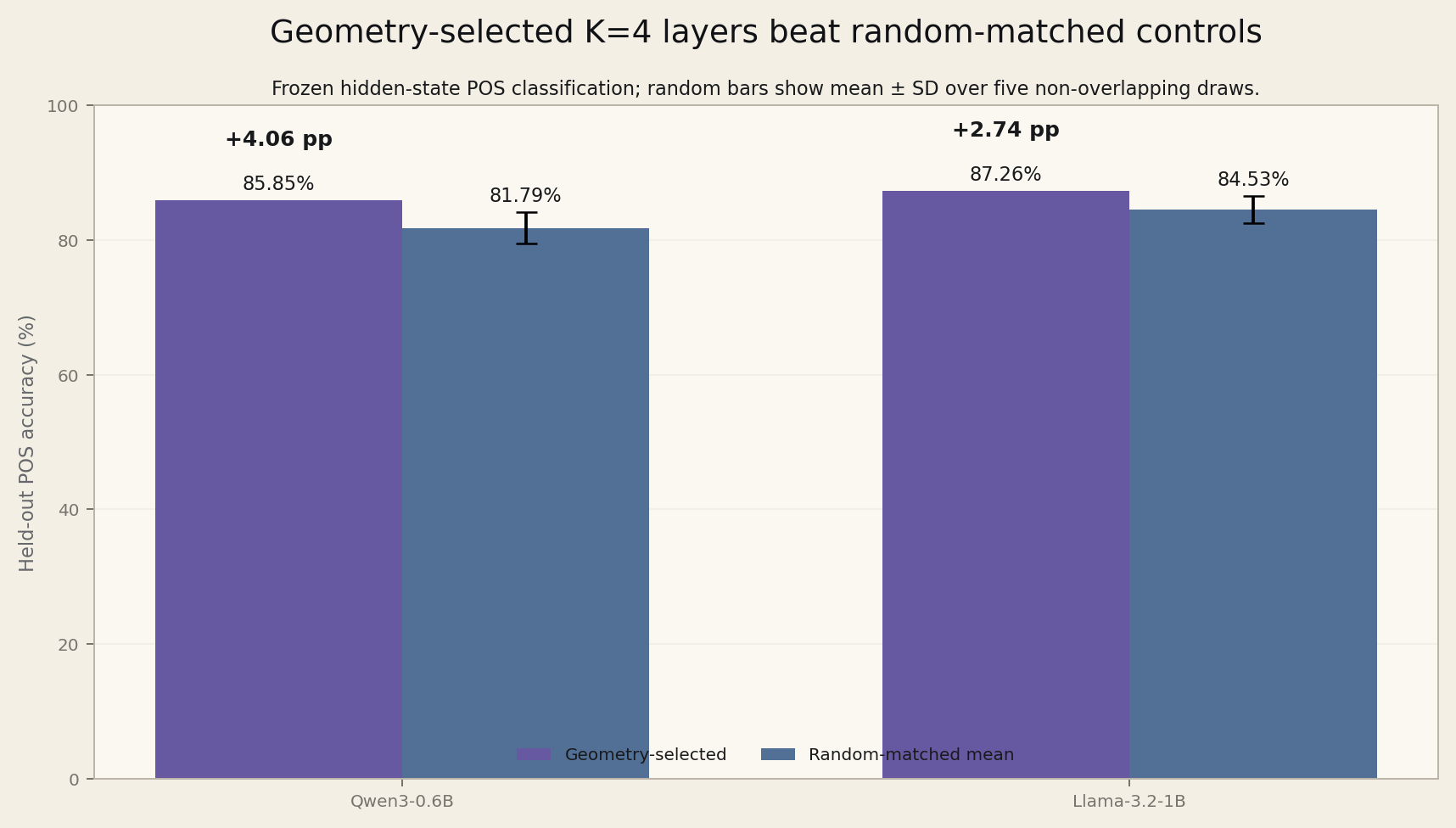
Development-selected layer groups carried stronger held-out POS signal than the random controls. At K=4, macro-F1 improved by 4.70 points for Qwen and 3.15 for Llama, beating all five random groups in each model. This tests frozen features; LoRA adaptation remains untested.
We fitted deterministic linear classifiers to concatenated frozen states from Qwen3-0.6B and Llama-3.2-1B. The replicated K=4 result motivates a small targeted-LoRA test. Adaptation and causal localization remain open questions.
Scope: frozen-feature classification. LoRA adaptation and causal localization of Arabic morphology remain untested.
Related Arabic forms share roots, lemmas, and surface patterns. Random splits can reward that overlap; grouped splits test transfer across lexical groups.
random layer adaptation is also a weak control unless it is matched. changing the number of layers, target modules, adapter rank, data, or training budget changes capacity or compute along with layer choice.
the contrast i care about is narrower: geometry-selected layers versus non-overlapping random layers, with everything else held fixed.
the local control cannot tell me whether targeted LoRA will work. it can tell me whether the proposed intervention has enough signal to be worth running before i spend money on real training.
dataset paths, SHA-256 checksums, split identifiers, and selection
provenance were held fixed. future-LoRA manifests also declare the
same q_proj/v_proj target group, rank 8,
alpha 16, and matched expected adapter counts within each K.
The module metadata is reserved for future manifest parity. sklearn concatenates selected layers’ frozen hidden states and fits a linear classifier; q_proj and v_proj remain untouched.
| model | K | geometry test | random mean ± SD | difference | wins | percentile |
|---|---|---|---|---|---|---|
| Qwen3-0.6B | 1 | 83.49% | 84.91% ± 1.16 | −1.42 pp | 1/5 | 20th |
| Qwen3-0.6B | 2 | 83.96% | 82.83% ± 2.61 | +1.13 pp | 4/5 | 80th |
| Qwen3-0.6B | 4 | 85.85% | 81.79% ± 2.32 | +4.06 pp | 5/5 | 100th |
| Llama-3.2-1B | 1 | 87.74% | 85.09% ± 2.10 | +2.64 pp | 5/5 | 100th |
| Llama-3.2-1B | 2 | 85.38% | 85.28% ± 2.22 | +0.09 pp | 3/5 | 60th |
| Llama-3.2-1B | 4 | 87.26% | 84.53% ± 2.03 | +2.74 pp | 5/5 | 100th |
K=4 is positive for both models and beats all five non-overlapping random controls in both cases. macro-F1 improves by 4.70 points for Qwen and 3.15 points for Llama.
the K=1 and K=2 rows matter too: Qwen K=1 fails this control, and Llama K=2 is effectively neutral. the result is not “selected layers always win.” it is a replicated local signal at K=4.
the table reports geometry minus the random-control mean on the held-out test split.
| model | class | precision Δ | recall Δ | F1 Δ |
|---|---|---|---|---|
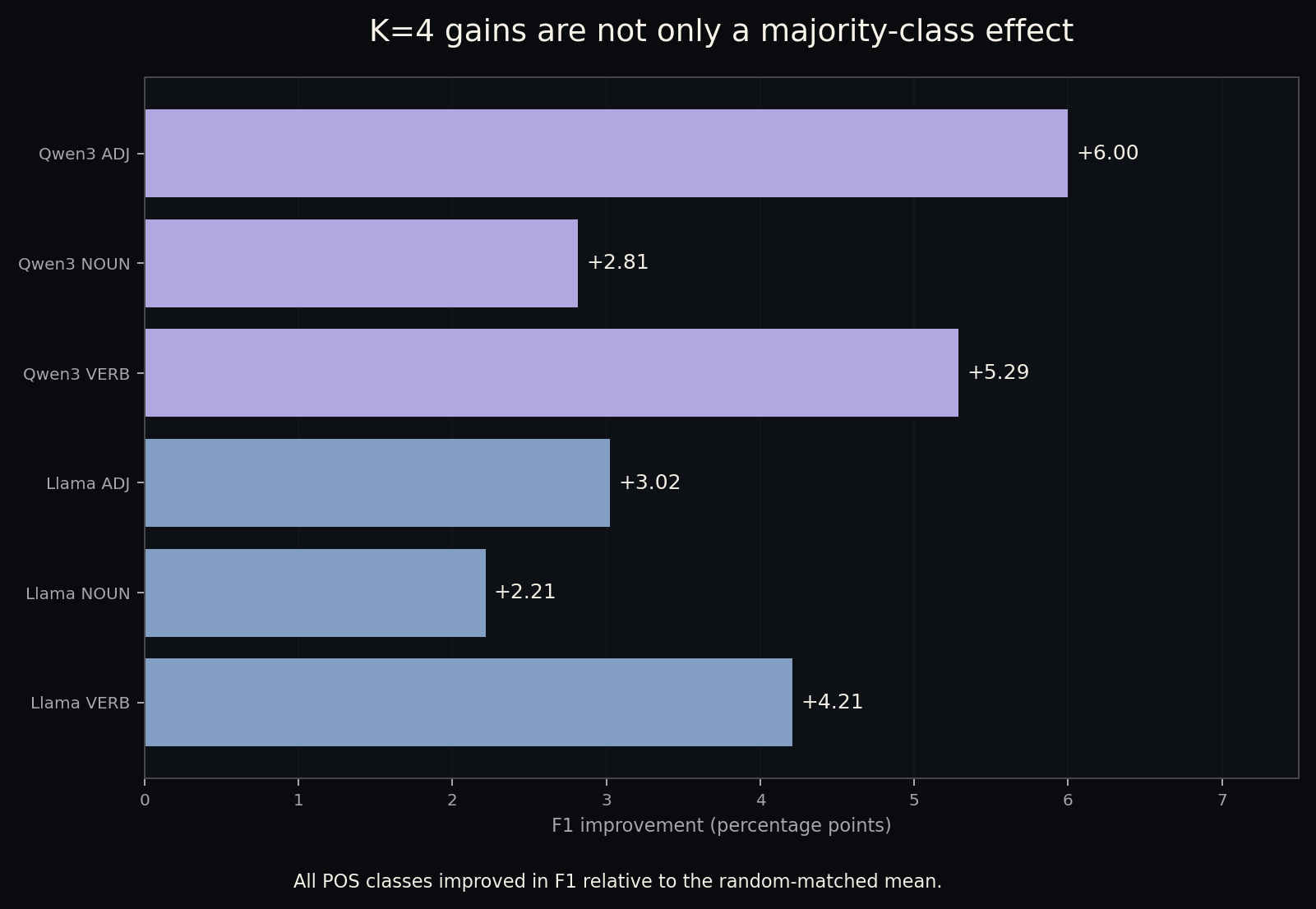
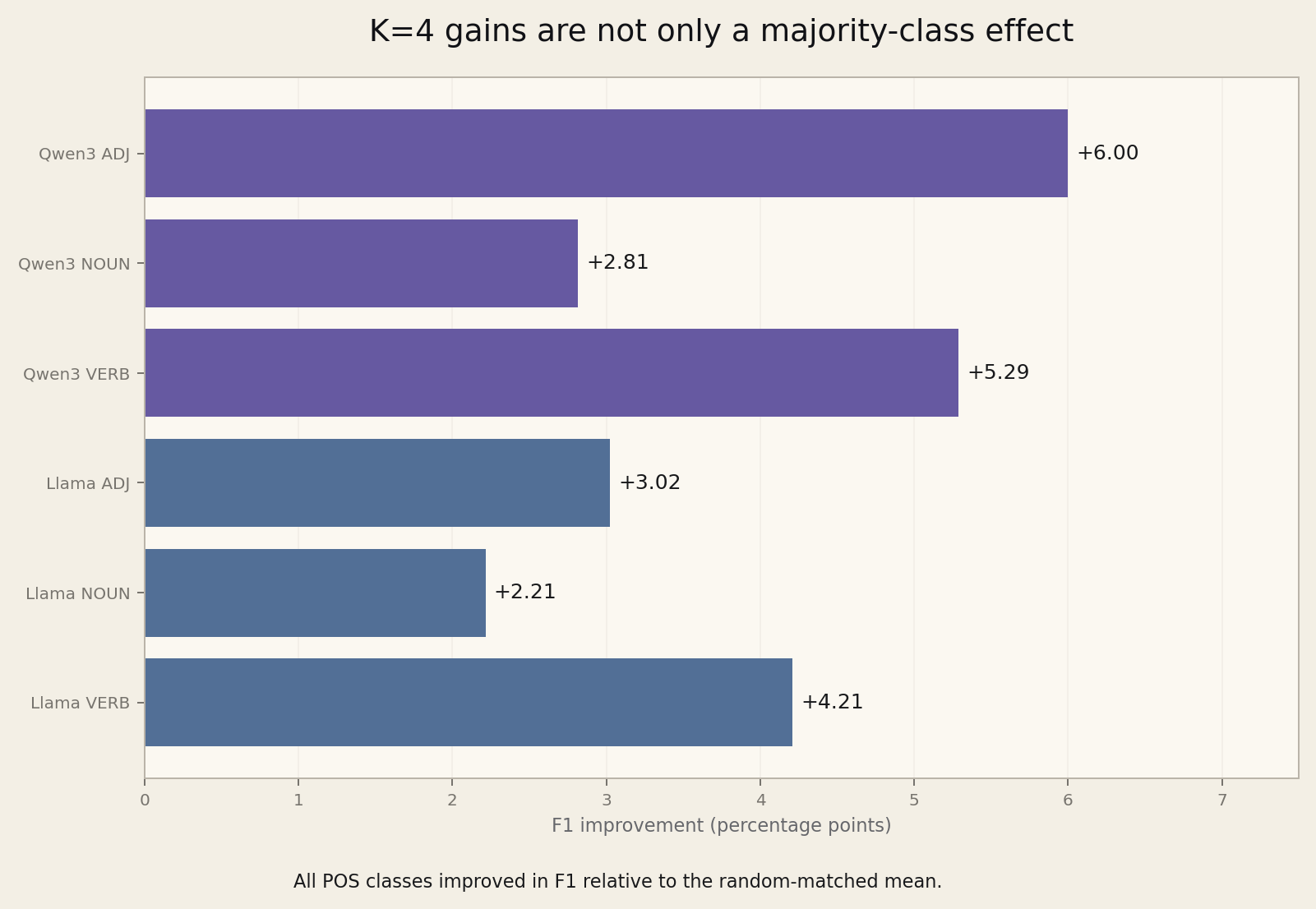
| Qwen | ADJ | +8.17 pp | +3.81 pp | +6.00 pp |
| Qwen | NOUN | −0.19 pp | +5.37 pp | +2.81 pp |
| Qwen | VERB | +8.71 pp | −0.56 pp | +5.29 pp |
| Llama | ADJ | +0.57 pp | +5.71 pp | +3.02 pp |
| Llama | NOUN | +1.76 pp | +2.54 pp | +2.21 pp |
| Llama | VERB | +6.37 pp | 0.00 pp | +4.21 pp |
the first intervention is already frozen: Qwen3-0.6B, POS, K=4,
geometry layers 7, 8, 18, 20, and five fixed
non-overlapping random controls. every run targets
q_proj/v_proj with rank 8, alpha 16, and
exactly 163,840 trainable adapter parameters. the budget is 200
optimizer steps.
the primary metric is held-out POS macro-F1. success requires the geometry condition to exceed the arithmetic mean of the five random controls and strictly beat at least three of them. accuracy and per-class F1 are secondary diagnostics.
before execution, the model and tokenizer revisions, backend, maximum sequence length, batch and accumulation settings, learning rate, optimizer, scheduler, warmup, weight decay, dropout, precision, evaluation cadence, and checkpoint policy must be frozen. early stopping is disabled for the pilot.
this is a local proof-of-life. development-ranked K=4 layer groups carry stronger held-out POS signal than five non-overlapping random groups in two small decoder models, and the gain appears across all three POS classes.
that justifies the intervention experiment. it does not yet claim adaptation success.