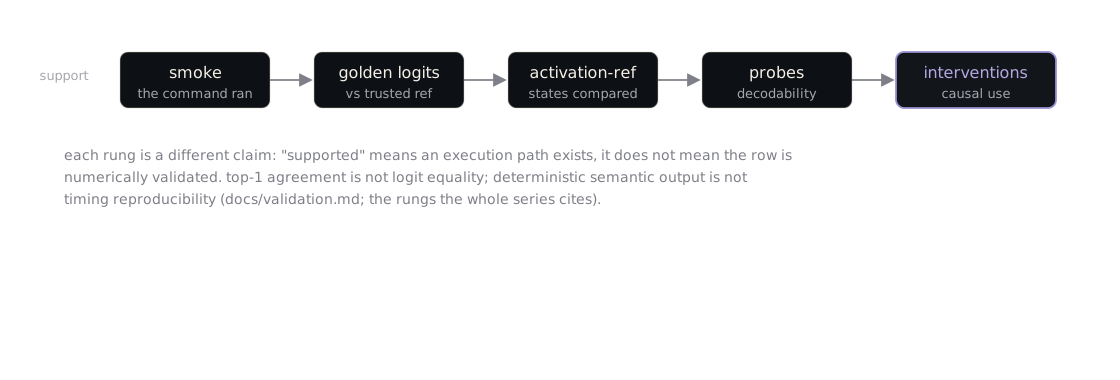
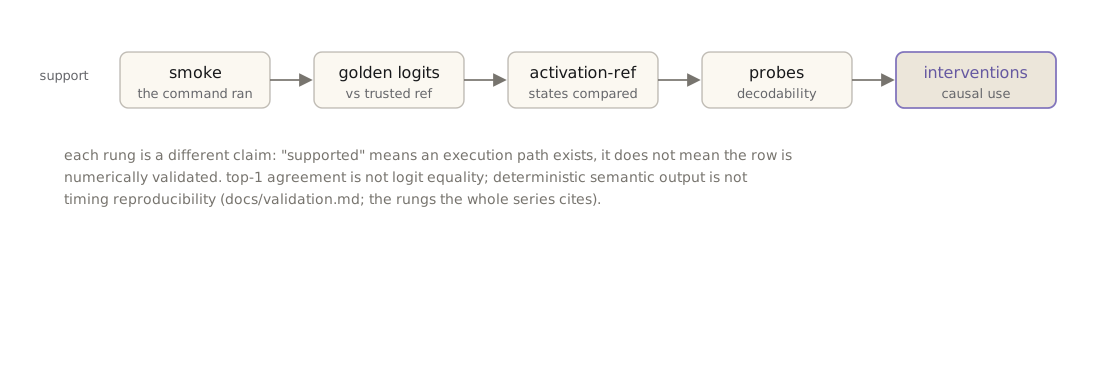
The 1.0 priority is a dependable CLI workflow for capture, intervention, bundles, and verification on a short, explicitly validated model list. Consoles, agent tooling, and security research remain separate extensions; their breadth does not define readiness for 1.0.
Status (2026-09-28): the 1.0 line is prepared at v1.0.0 and the local release gates are green; the tag waits on external clean-machine, independent-user, and desktop-accessibility acceptance. Per-gate status and evidence: docs/road-to-1.0.md.
building an inference engine that gets faster without becoming harder to trust. Ember is a CPU-first Rust research layer for hidden-state extraction, causal intervention, and reproducible experiments over GGUF models. it has its own inference path, not to beat llama.cpp at throughput, but because a model that runs is not the same as a model you can inspect, patch, and verify. this series follows that path release by release, failures included.
| release | date | what it added | one-line thesis |
|---|---|---|---|
| v0.1.0 | 2026-07-31 | GGUF loading, CPU prefill/decode, KV cache, tracing, hidden-state extraction, deterministic benchmarking | inference made legible enough for model-internals research |
| v0.2.0 (retroactive tag) | impl. 2026-08-01 | activation capture, intervention hooks, activation replacement, patching between runs, exact restoration, structured artifacts | from descriptive observation to causal experiments |
| v0.3.0 | 2026-08-03 | native Q4_K/Q6_K execution, packed mmap-resident weights, scalar + AVX2 kernels, external parity | quantized on disk, quantized in memory |
| v0.4.0 | 2026-08-04 | immutable execution plans, scratch arenas, frozen fusion set with hook-driven de-fusion, column-parallel matvec | plan the token once; keep every hook observable |
| v0.5.1 | 2026-08-04 | ember.experiment.v1 specs, byte-exact token selection, semantic hooks, deterministic bundles, offline verification | reproducibility as a runtime feature |
| v0.6.8 | 2026-08-25 | agent runtime and tools with approval gates, trace replay, payload digests, HTML reports | tooling breadth without touching the inference core |
| v1.0.0 | 2026-09-28 | strict versioned experiment contracts, six semantic hook sites with exact restoration, GPUI Kit console, reproducible golden ladder, scoped K-quant numerical contract | contracts other researchers can safely build on |
start with part 0, and if you run model-internals experiments, part 5 shows a workflow you can run today without writing Rust. each post is self-contained and cites the repository artifacts behind its claims, including the ones that failed.
series planning package and evidence: docs/road-to-1.0-plan.html and the
per-part evidence files under artifacts/benchmark-v0*/ in the
ember repository.