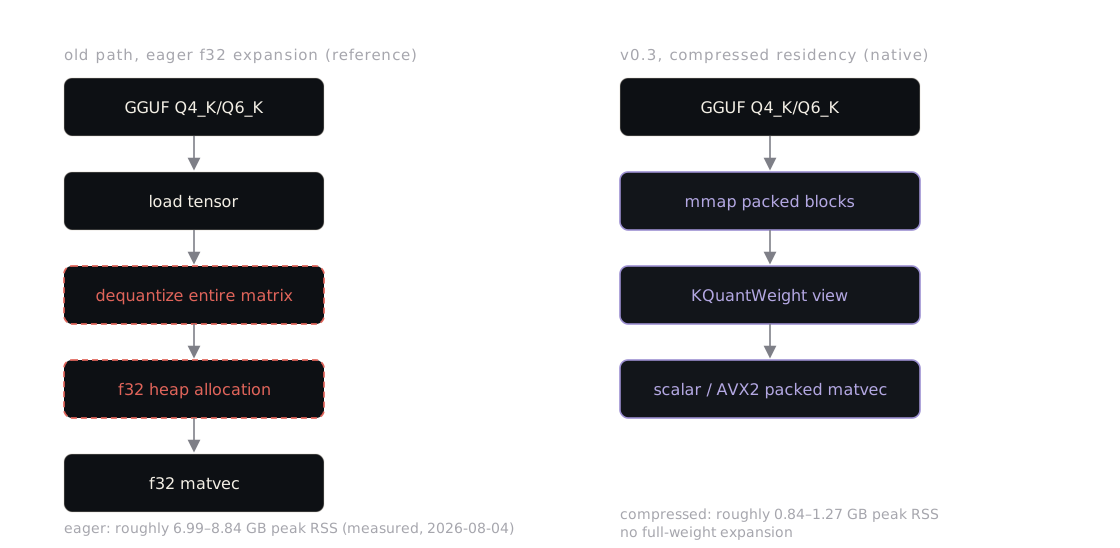
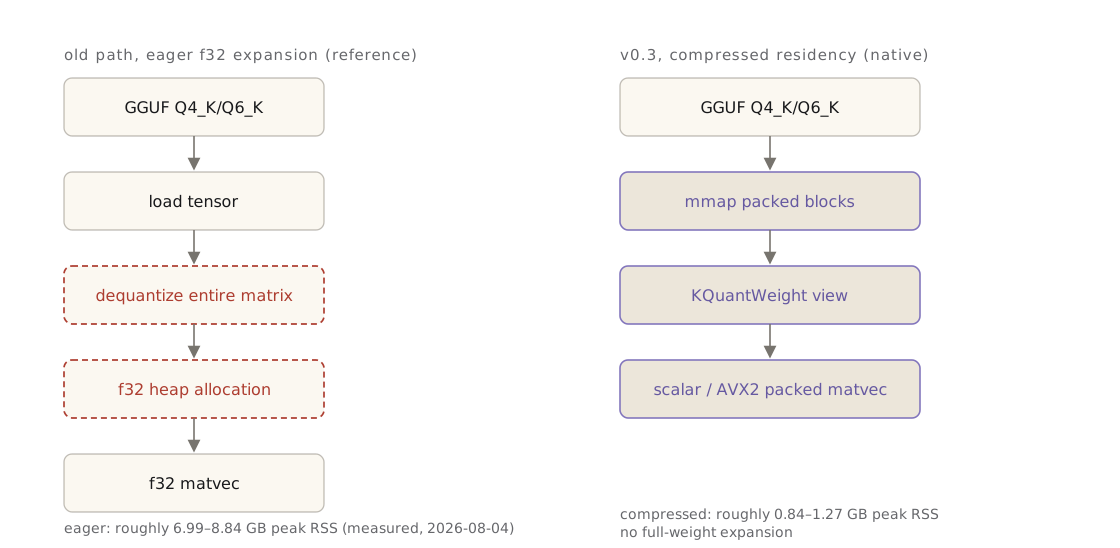
complete draft with explicit citations to repository artifacts. figures are embedded as SVG
(dark/light theme variants under figures/) with captions citing the evidence.
the performance and memory numbers cited here were re-derived from tagged builds on
2026-08-04 and recorded in
artifacts/benchmark-v03/part3-binary-memory.md; release-time values are
cited from artifacts/benchmark-v03/bench-summary.json and
docs/validation.md.
the file said Q4. the runtime said f32. the model was smaller on disk and just as large in RAM, until v0.3 stopped the runtime from undoing the model's compression.
a quantized checkpoint is a promise about size. Q4_K_M means roughly four bits per weight on disk, and the file delivers: Llama-3.2-1B at Q4_K_M is about 39% smaller than the same model at Q8_0. the promise breaks when the runtime loads it. Ember's loader before v0.3 dequantized every K-quant tensor to f32 at load time and kept the expanded buffers resident, then ran everything through generic f32 kernels. the checkpoint stayed Q4 on disk; the running model was f32 in memory.
the consequences were measured before v0.3, in the frozen baseline note
(docs/research-notes/the-file-said-q4-runtime-said-f32.html), on the same
machine that produced the release benchmarks:
| model | file | eager decode tok/s | eager peak RSS | runtime representation |
|---|---|---|---|---|
| Qwen2.5-1.5B | Q4_K_M 1066 MB | 2.6 | 8712 MB | persistent f32 expansion |
| Qwen2.5-1.5B | Q6_K 1396 MB | 2.5 | 8713 MB | persistent f32 expansion |
| Llama-3.2-1B | Q4_K_M 770 MB | 3.2 | 6965 MB | persistent f32 expansion |
| Llama-3.2-1B | Q6_K 974 MB | 2.9 | 6965 MB | persistent f32 expansion |
| Llama-3.2-1B | Q8_0 1260 MB | 149.6 | 2685 MB | compressed-resident |
across the four Q4/Q6 rows, peak RSS was 2.59×–4.49× higher than the Q8_0 baseline and decode was 15.6×–51.6× slower. the only axis on which the lower-bit files were smaller was the file itself. Qwen Q4_K_M is about 41% smaller on disk than Q8_0 and uses about 4.49× the peak RSS while decoding about 15.6× more slowly.
that is the question this release answers: what is the point of a Q4 model if the runtime expands it back to f32?
the dequant-to-f32 loader was not lazy. it was the correct engineering choice for a research
engine whose first job is numerical honesty: one representation, one generic kernel path,
no per-dtype execution to validate. the v0.3 contract
(docs/v03-execution-contracts.md) states the cost plainly in section 3:
resident weight memory is 4× the compressed size, Llama-3.2-1B Q6_K is 1.02 GB on disk and
~4.1 GB as resident f32, and every matmul is a dense f32 gemm.
the problem was never that the reference path existed. it was that the reference path was the only path. a Q4 file that must be expanded to f32 before it can run is not a low-memory deployment; it is a research loader that happens to read Q4 files.
three measurements made the change unavoidable. first, the eager path's peak RSS tracked the
expanded weights, not the file: ~6.99 GB for Llama Q4_K_M/Q6_K and ~8.83 GB for
Qwen2.5-1.5B on this machine (reproduced 2026-08-04, see section 2 of
artifacts/benchmark-v03/part3-binary-memory.md). second, the pinned llama.cpp
reference ran the same files at 1.08–1.77 GB peak RSS
(artifacts/benchmark-v03/bench-summary.json). third, the eager K-quant decode
was slower than the model's own Q8_0 run on the same machine by one to two orders of
magnitude. none of this is a claim that Q4 is "worse" than Q8, it is a statement about
what a runtime does with a file.
the constraint, frozen before implementation
(docs/v03-execution-contracts.md, status line): the weights stay packed and
mmap-resident, and dequantization happens only at block or tile granularity inside the
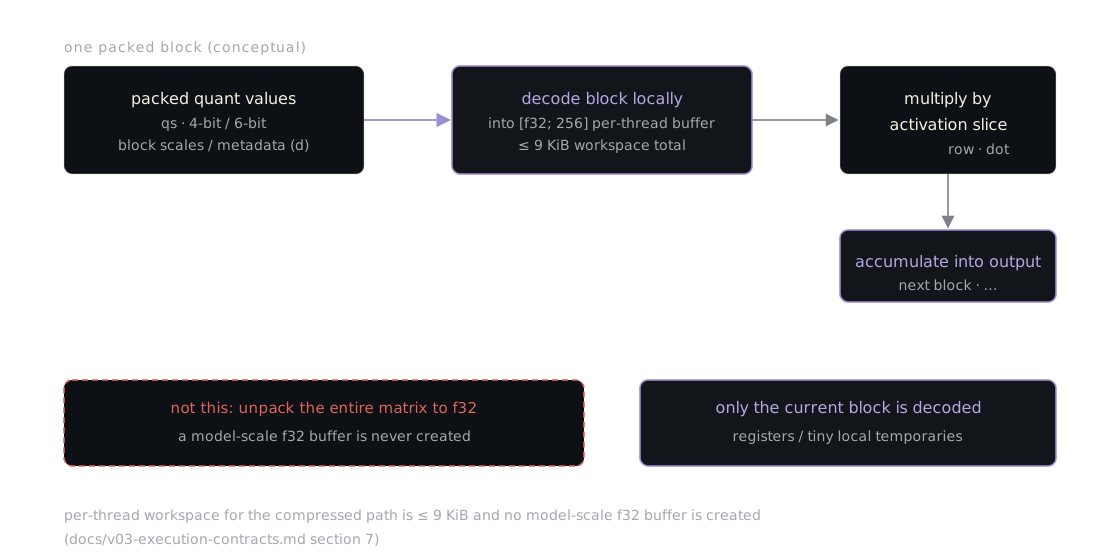
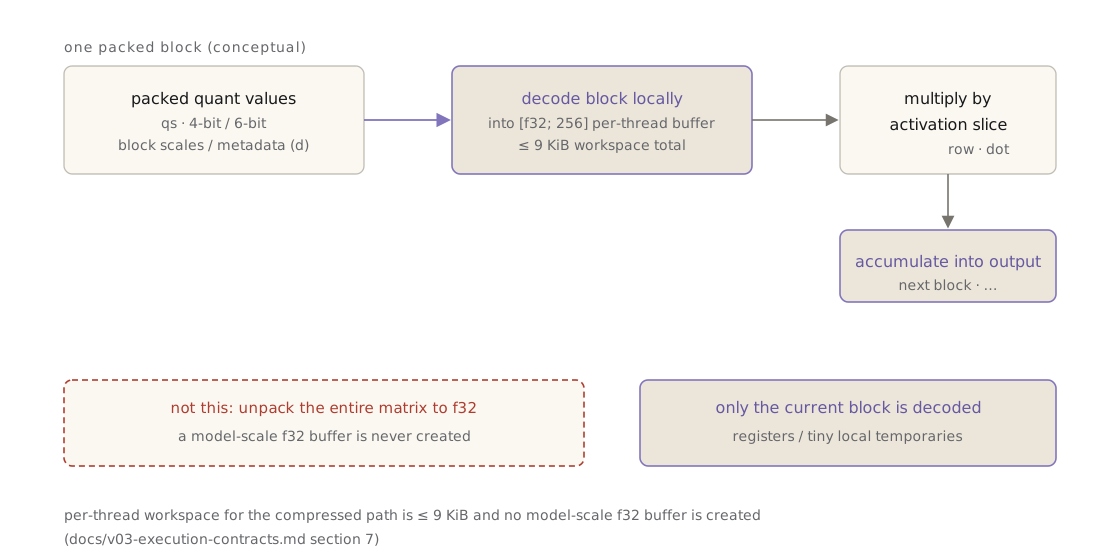
matmul kernels. no persistent full f32 expansion exists for native-path tensors. the
contract also froze the limits of the change:
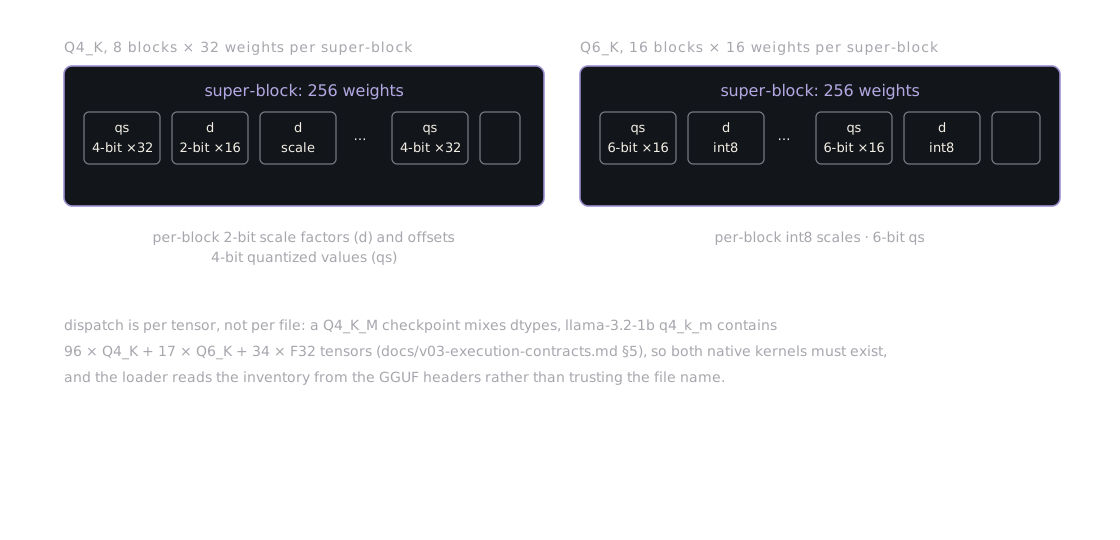
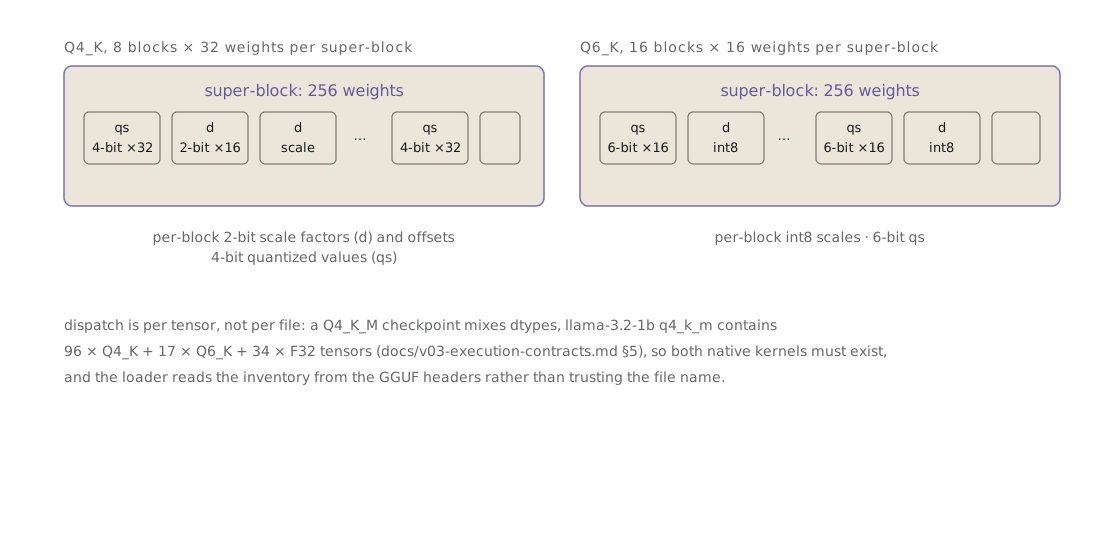
K-quants are not one format. a Q4_K tensor stores 8 blocks per super-block with per-block
scales and offsets; Q6_K stores 16 blocks per super-block with int8 scales; a "Q4_K_M"
model is a per-tensor mix, the Llama-3.2-1B Q4_K_M file contains 96 Q4_K tensors,
17 Q6_K tensors (attention value + FFN down in selected layers, plus the tied embedding),
and 34 F32 tensors for norms and biases (inventory in
docs/v03-execution-contracts.md section 5). a native path therefore has to
dispatch per tensor, not per file, and Q4_K_M forces both Q4_K and Q6_K kernels to exist.
the loader also has to respect the 2024 dtype-numbering shift (Q2_K=10 … Q6_K=14 in GGUF) ,
silently misreading a K-tensor type would corrupt every weight without an error (dtype range
documented in docs/v03-execution-contracts.md section 3). and the per-tensor
reality means "Q4" is never claimed from the file name; the inventory is parsed from the GGUF
headers.
the new representation (KQuantWeight in src/quant_k.rs) mirrors
the existing Q8_0 compressed-resident template: raw block storage backed by the mmap, with
checked construction (block alignment, byte length, mapped range). dequantization reuses the
already-reference-validated dequant_q4_k/dequant_q6_k functions
at block granularity. on top of that:
--k-strategy eager-f32|scalar|x86|auto;
unsupported dtypes under an explicit compressed strategy hard-fail naming the tensor
unless --k-allow-fallback is given; auto chooses x86 when
available and records the decision (contract section 6).the kernel shape battery in the unit tests is deliberately wide, rows {1,2,8,32} × in {256,512,1536,2048,8960} × out {128,512,2048}, plus zero-scale, negative-min, saturated, and non-aligned edges (contract section 9, gate a).
the gates were pre-registered in the contract before implementation and could only be tightened, never loosened to fit results. four are numerical; the fifth is the causal workflow:
max_abs ≤ 1e-4·scale across the shape battery
and edge cases; AVX2 vs scalar within tolerance.max_abs ≤ 5e-4·scale, cosine ≥
1−1e-6, logits ≤ 1e-2 (qwen amended to 2e-2), greedy token sequences identical on the
frozen prompt set. a token flip is a failure to investigate, not a threshold to relax.docs/validation.md v0.3 section). Top-1 agreement is agreement on the
argmax, not equality of logits.docs/validation.md).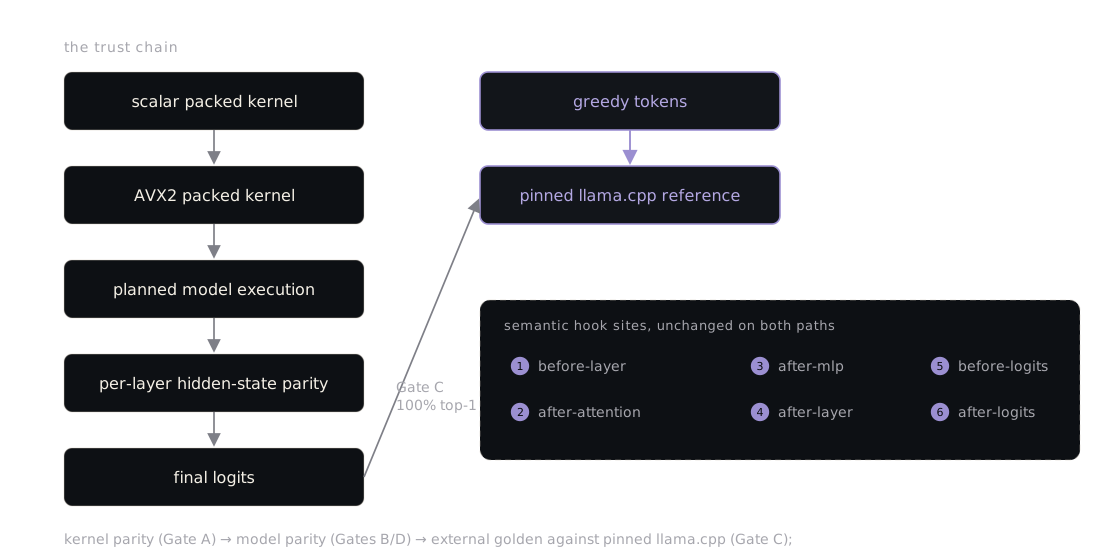
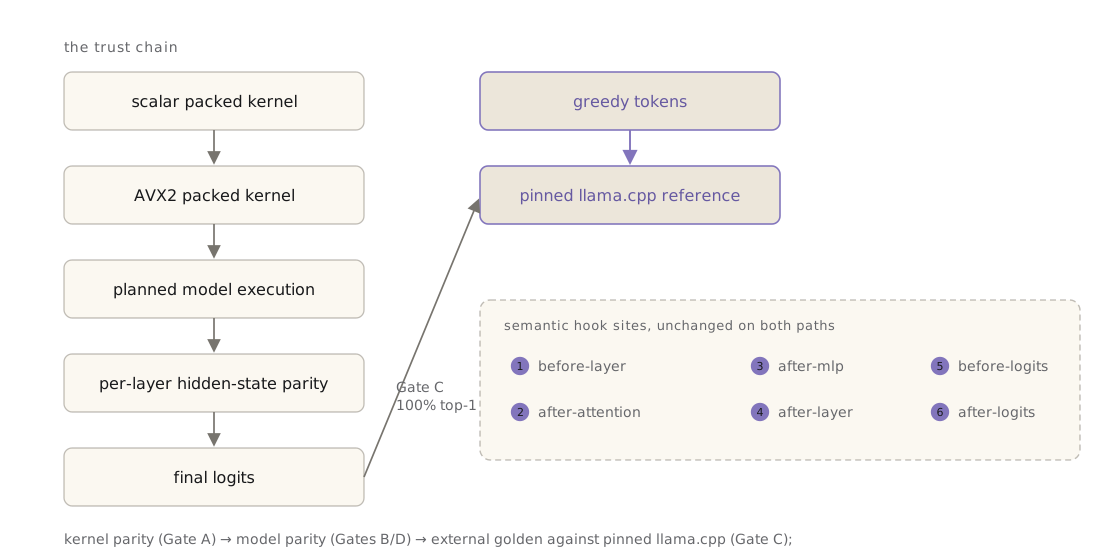
the honest part of gate c is its amendment history, which the contract records verbatim. the first drafted bound (max abs ≤ 1e-2 on final logits) misread the existing golden standard, the pilot's own Q8_0 report showed max abs 0.364 against llama.cpp's integer accumulation kernels, so no accumulation-order change could reach 1e-2 on this family. the evidence-based standard became top-1 100%, cosine ≥ 1−1e-3, mean ≤ 0.1, max ≤ 1.0; a second amendment moved the single-element max gate from 0.5 to 1.0 after one extreme element of 128k per sample proved quantizer- and order-sensitive; a third set the final per-family envelopes from the full six-rung run. none of these changed the primary gate , top-1 agreement stayed 100% throughout.
re-derived on 2026-08-04 from the v0.3.0 tag build (full commands and raw values in
artifacts/benchmark-v03/part3-binary-memory.md), the same protocol as the
release matrix (scripts/bench_v03.sh, 64 tokens, 1 warmup, 3 reps, 8 threads,
whole-process peak RSS):
| model | strategy | median tok/s | peak RSS |
|---|---|---|---|
| Llama-3.2-1B Q4_K_M | eager-f32 | 0.98 | 6,989,724 KB (6.67 GiB) |
| Llama-3.2-1B Q4_K_M | compressed (x86) | 2.01 | 844,216 KB (0.81 GiB) |
| Llama-3.2-1B Q6_K | eager-f32 | 0.98 | 6,989,252 KB (6.67 GiB) |
| Llama-3.2-1B Q6_K | compressed (x86) | 2.21 | 1,053,524 KB (1.00 GiB) |
| Qwen2.5-1.5B Q4_K_M | eager-f32 | 0.87 | 8,828,632 KB (8.42 GiB) |
| Qwen2.5-1.5B Q4_K_M | compressed (x86) | 1.66 | 987,360 KB (0.94 GiB) |
| Qwen2.5-1.5B Q6_K | eager-f32 | 0.85 | 8,837,276 KB (8.43 GiB) |
| Qwen2.5-1.5B Q6_K | compressed (x86) | 1.67 | 1,266,684 KB (1.21 GiB) |
the compressed path cut peak RSS by 6.6×–8.9× versus eager on the same binary, and decode
improved 1.9×–2.3× in this session. the release-time matrix recorded similar speedups
(1.94×–2.75×) and the resident-weight footprint at file size: 799.6 MB compressed vs ~3.2
GB expanded for Llama Q4_K_M, 1457.6 MB vs ~5.83 GB for Qwen Q6_K
(artifacts/benchmark-v03/bench-summary.json,
docs/v03-execution-contracts.md section 5). the pinned llama.cpp reference ran
the same files at 1.08–1.77 GB peak RSS, Ember's compressed path now sits in the same
neighborhood, which is where a quantized model should live.
the eager arms of this reproduction match the frozen pre-v0.3 baseline within 0.4%
(6,989,724 KB vs the recorded 6,965 MB for Llama Q4_K_M), which is the sanity check that
the comparison is measuring the representation change, not machine drift
(artifacts/benchmark-v03/part3-binary-memory.md section 2).
binary cost: measured growth from v0.2.0 to v0.3.0 is 820,480 b (~801 KiB) on the current toolchain (rustc 1.95.0). an internal estimate of "~190 KB" does not reproduce under this toolchain; the measured value is recorded in the evidence file. the release added roughly 0.8 MiB of kernels, dispatch, and provenance to the executable, against 6–8 GiB of memory it removed.
keeping weights packed fixed the memory problem, but decode still ran the generic hooked path with per-token dispatch rediscovery and per-token scratch. the next release, v0.4, plans that execution once per model, and the plan interpreter runs on exactly this compressed substrate. the memory the native path saved is the memory the plan-driven runtime then refuses to reallocate.